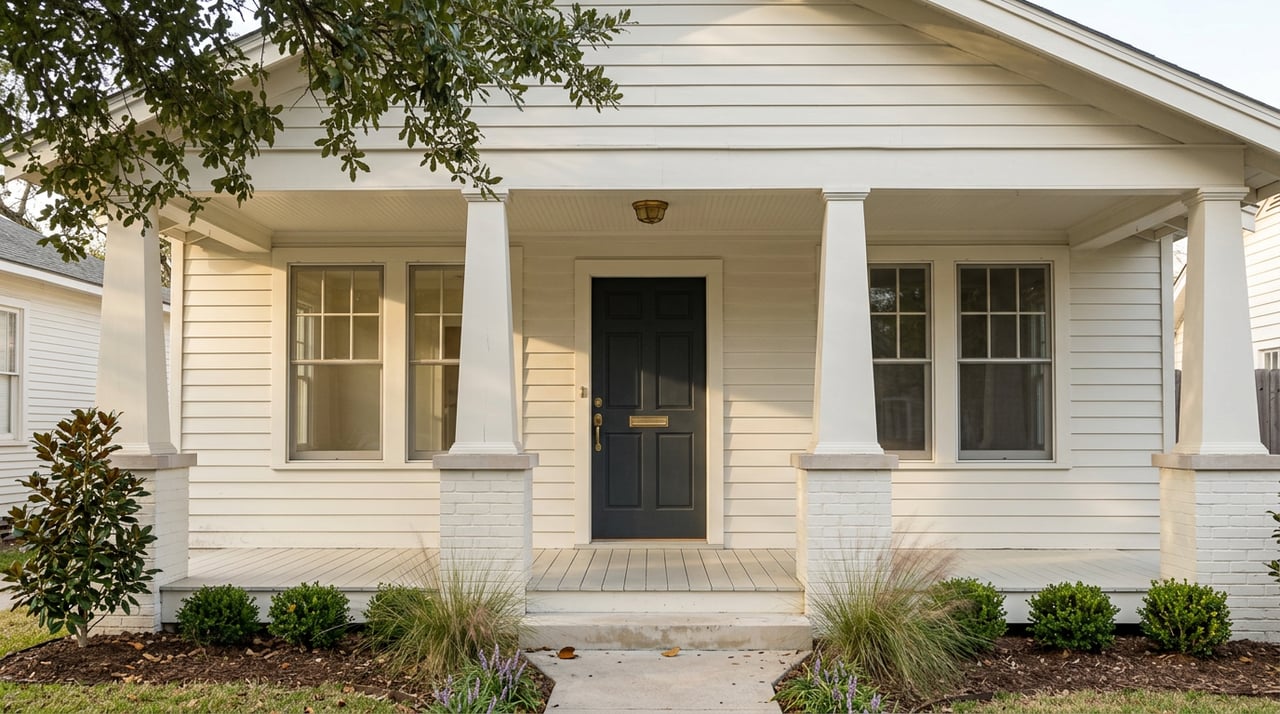
A buyer puts an offer on a two-story frame house near Main Street, plans to swap the aluminum storm windows for something period-correct before move-in, and assumes that's a contractor conversation, not a closing-timeline conversation. Then someone mentions the Certificate of Appropriateness. The buyer has never heard the phrase. Their lender hasn't either, because it has nothing to do with financing. It has to do with a public meeting that happens once a month, and if the paperwork misses this month's cutoff by even a few days, the whole renovation plan waits for the next one.
That's the version of Grapevine that doesn't show up in a market snapshot. Before getting to the calendar, it's worth looking at why the snapshots themselves can't be trusted to describe it.
Three Reports, Three Different Grapevines
Pull three market trackers for Grapevine from the past year and you get three different cities.
| Source | Reporting Window | Median Sale Price | Days on Market | Homes Sold |
|---|---|---|---|---|
| Redfin | 3 months ending April 2026 | $627,000 | 29 days | 131 in April |
| Orchard | Last 30 days (captured late May 2026) | $635,000 | 19 days | 20 |
| Movoto | November 2025 | $649,000 | 61 days | 113 |
None of these are wrong. They're measuring different denominators. Redfin's April window rests on 131 closed sales, a large enough sample that its 29-day average is probably a fair read on the broader city. Orchard's snapshot is built on 20 sales, down from 58 the year before, which means a single luxury closing or a single distressed sale can swing that median by tens of thousands of dollars in either direction. Movoto's figure is nine months old at this writing, but it shows the same city posting a 61-day average less than a year ago, not the 19 or 29 days the newer snapshots report. That's not a typo. That's what happens in a market where, as anyone tracking absorption block by block will tell you, supply moves through resale turnover rather than large subdivisions releasing dozens of comparable homes at once.
The practical takeaway isn't which number is right. It's that a citywide median is close to useless if you're transacting inside a specific pocket of Grapevine, and the historic core is the most specific pocket of all.
The Real Border Isn't a Zip Code
Grapevine's historic protection doesn't follow a zip code or a neighborhood name. It follows an overlay the city has been building since 1991, when the Historic Preservation Ordinance created the Historic Preservation Commission and a historic district zoning category. Since then, six local historic districts have been added one at a time:
- Grapevine Commercial Historic District, adopted 1992
- College Street Historic District, adopted 1993
- Historic Township District, adopted 1998
- Cotton Belt Railroad Historic District, adopted 2002
- West Wall Street Historic District, adopted 2004
- D.E. Box Addition Historic District, adopted 2011
Four individual properties carry Recorded Texas Historic Landmark status on top of that: the Torian Cabin at 201 South Main Street, the Tarrant County State Bank at 332 South Main Street, Nash Farm at 626 Ball Street, and the Dorris-Brock House at 805 North Main Street, now home to Cross Timbers Winery. If your address falls inside any of these boundaries, or you're eyeing a purchase near one, the rules that apply to your home are not the rules that apply three blocks away.
What a Certificate of Appropriateness Actually Requires
Inside these districts, any exterior alteration, demolition, or new construction needs a Certificate of Appropriateness from the Historic Preservation Commission before it happens. Not after. Before.
Some of this moves fast. Routine, minor modifications can be approved by city staff within days of an application going in. But anything more substantial, a new roofline, a window replacement, an addition, exterior paint outside the commission's approved color palette, goes to the full Commission, which meets on the fourth Wednesday of every month at 6 p.m. in the City Hall Council Chambers on South Main Street. A completed application, with drawings, dimensions, and material samples, has to be submitted four full weeks ahead of that meeting to even get on the agenda.
And approval of the Certificate of Appropriateness is not the same as a building permit. That's a separate submission, and for properties inside the Historic Township boundary, a documented pre-construction meeting is required before the permit gets issued at all.
None of this is punitive. The city provides architectural design assistance at no cost specifically so property owners don't have to guess at what will pass review. But it does mean the renovation timeline in a historic Grapevine sale runs on a different clock than the one your lender is watching.
What This Means for Your Closing Date
Picture a standard 30 to 45 day close with a renovation contingency attached to visible exterior work. If that work hasn't already cleared a Certificate of Appropriateness, and the contract closes before the next fourth Wednesday, the buyer is either closing without the work approved or waiting out a second commission cycle.
A rule of thumb worth writing into any historic-district contract: if exterior work is part of the plan, confirm the next two HPC hearing dates before you agree to a closing date, not after.
This is the friction a generic buying guide never mentions, because it doesn't exist outside these six districts. It's also the reason a seller inside the overlay should disclose whether any Certificate of Appropriateness applications are open, pending, or recently denied. A buyer who finds out about a stalled application after the option period has closed has a much worse afternoon than one who found out during it.
The Grant Most Buyers Don't Know They're Getting
The same ordinance that slows down exterior changes also subsidizes them. The Grapevine Township Revitalization Program offers a matching grant for exterior rehabilitation work on historic homes: up to $10,000 on a 2-to-1 match for owner-occupied properties, and up to $5,000 on a 1-to-1 match for rental houses. A homeowner contributing $5,000 toward an approved restoration can draw the full $10,000 match. That's real money that a seller can point to as a documented, city-backed incentive for a future owner, and real money a buyer can build into a renovation budget before ever picking up a hammer.
Pair that with the free design assistance from the Historic Preservation Office, and the process that looks like a bureaucratic hurdle from the outside starts to look more like a built-in advisor and a partial rebate, if you know to ask for it before you're mid-renovation and out of matching funds.
If You're Already Under Contract, or About to List
A few concrete steps before ink dries on either side of a historic-district deal:
- Confirm which of the six districts, or which individual landmark boundary, your address actually sits inside. The map isn't intuitive from the street.
- Call the Historic Preservation Office before finalizing any renovation contingency language, not after the option period starts.
- Ask whether your planned work qualifies for staff-level approval or requires a full Commission hearing, since that difference alone can be the gap between a week and two months.
- If you're selling, check whether an open Certificate of Appropriateness application exists on the property and disclose its status.
- If you're buying, ask about the Township Revitalization matching grant before you price out the renovation on your own dime.
A Few Common Questions
Does every older home in Grapevine need a Certificate of Appropriateness? Only homes inside one of the six designated historic districts or carrying individual landmark status. An old house outside those boundaries isn't subject to the same review, even if it looks similar architecturally.
How long does approval actually take once an application is submitted? Minor, routine changes can clear at the staff level within days. Anything requiring full Commission review is bound to the monthly fourth-Wednesday hearing schedule, and the application has to be complete four weeks before that date to be considered.
Can a sale close while a Certificate of Appropriateness application is still pending? Yes, but both parties should know exactly what's pending and what happens to that application if ownership changes hands mid-review. This is a conversation for the contract, not a surprise for the walkthrough.
If you're weighing a purchase or a listing inside one of Grapevine's historic districts, this is exactly the kind of transaction where knowing the calendar matters as much as knowing the comps. Jessica Cazares Team has walked buyers and sellers through construction-adjacent decisions like this one across North Texas, and can tell you before you sign anything whether your timeline is realistic or quietly optimistic.
